
From Metrics to Meaning: Designing KPIs That Actually Drive Behavior
#customerinsights #analytics #cxdata
by Sebastiano Piras
We don’t have a data shortage. We have a clarity problem.
Today’s organizations are surrounded by dashboards. Every team has a set of KPIs, scorecards, and quarterly targets. But while we’ve gotten better at measuring things, we haven’t always gotten better at using that information to make decisions.
Some metrics are useful. Some are noise. And others are just good-looking numbers that don’t mean much at all.
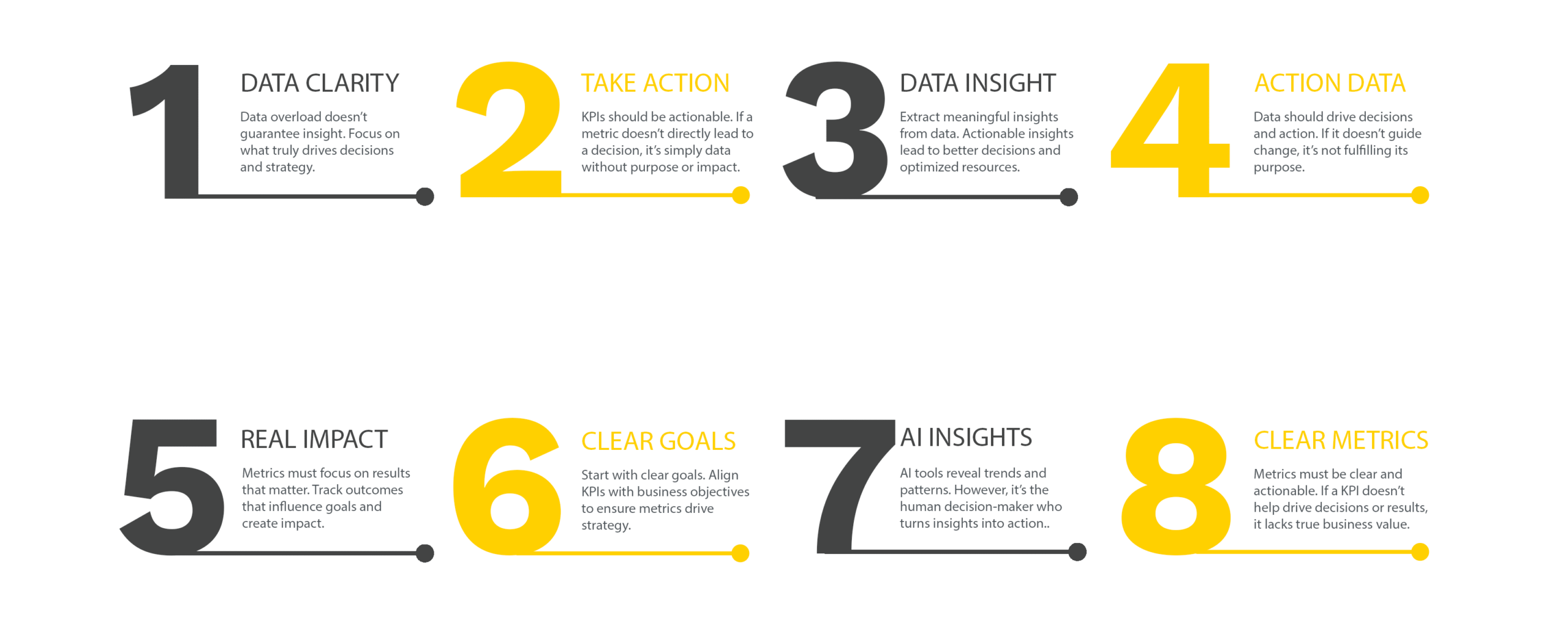
If a KPI doesn’t change behavior, it’s just a number. A good KPI doesn’t live in a dashboard. It lives in the decisions it shapes.
If a KPI doesn’t change behavior, it’s just a number. A good KPI doesn’t live in a dashboard. It lives in the decisions it shapes.
Sebastiano Piras X
The Illusion of Measurement
In 2025, nearly every team has access to advanced data visualization tools. Whether it’s Tableau, Power BI, or Looker Studio, we can chart anything: engagement curves, conversion funnels, ticket volumes, even live sentiment streams pulled from AI-enhanced feedback tools.
But visualization doesn’t always lead to insight.
One of today’s biggest risks is dashboard fatigue. The more data we surface, the harder it becomes to focus on what really matters. We start mistaking movement for progress, or thinking that a colorful chart implies clarity.
This is especially true in customer experience, where teams often report on dozens of KPIs across NPS, CSAT, CES, churn, and more. Each of them has a purpose, but not all of them have an impact.
In high-performing teams, data exists to support decisions. In average teams, it exists to support presentations.
Modern AI tools now make it easier than ever to generate metrics automatically. You can ask a tool like Notion AI to suggest KPIs based on goals. You can use ChatGPT to summarize feedback themes into trendlines. You can auto-populate dashboards with real-time updates from platforms like HubSpot, Zendesk, or Salesforce.
But even with these advances, the real challenge remains the same.
Does this number help someone take the right action at the right time? If it doesn’t, then no amount of formatting, automation, or AI enhancement will make it meaningful.
What Makes a KPI Actionable
With real-time analytics and AI-augmented dashboards, it’s easy to fall into the trap of tracking what’s available rather than what’s useful. But a KPI is only as valuable as the behavior it inspires.
A meaningful KPI doesn’t just summarize the past. It prompts a team to adjust, respond, or refocus. If a number changes and nothing happens, then it’s not a key performance indicator. It’s just metadata.
To be actionable, a KPI needs to:
- Have a clear owner, someone responsible for reviewing and reacting to it
- Be tied to a decision, where movement prompts change in priorities or resources
- Connect to a real-world impact, for a customer, employee, product, or experience
- Be reviewed frequently enough to shape behavior, not just appear in quarterly slides
In 2025, we have tools like AI-generated summaries, live predictive dashboards, and cross-platform integrations that make monitoring easier than ever. Systems like Amplitude and Mixpanel allow product and CX teams to build custom alerts and track behavior in real time. AI assistants can flag anomalies, suggest opportunities, and even draft your weekly report.
But even with that help, the human part of the loop matters most.
AI might highlight that churn risk has increased for a certain segment. But deciding whether to redesign the onboarding, reach out to customers, or revise the support playbook still requires context, judgment, and prioritization.
The most impactful KPIs aren’t always the ones that are easiest to automate. They’re the ones that help real people in your organization answer one of the hardest questions in business: What do we do next?
What Vanity Looks Like in CX
Customer experience teams today have more data than ever. With the rise of voice-of-customer platforms and AI-enabled chat analysis tools, it is now possible to quantify every interaction, comment, or pause in a customer’s journey.
But more data doesn’t always mean more clarity. And it definitely doesn’t mean more action.
The most common trap? Measuring performance without measuring behavior. CX dashboards often look impressive, dozens of tiles tracking NPS, CSAT, CES, and time on site, but very few of those metrics are connected to decisions or improvements.
Here’s what that looks like in practice:
| Surface Metric | Behavior-Based Alternative |
|---|---|
| Net Promoter Score (NPS) | Percentage of detractors contacted and resolved within 48 hours |
| Ticket volume | First-contact resolution for top complaint categories |
| Time on site | Task completion rate by intent segment (e.g. help-seekers vs. shoppers) |
| CSAT snapshot | Sentiment shift over time with linked agent action records |
| Customer Effort Score (CES) | CES paired with open-ended feedback analysis by product area or channel |
NPS on its own is no longer a competitive differentiator. Most companies measure it, but few know how to respond to it meaningfully. If you’re collecting NPS and not running follow-up workflows, action logs, or resolution tracking, you’re just sampling sentiment, not shaping it.
Ticket volume is a weak signal. It tells you how often customers reach out, but not why, or whether you resolved the issue efficiently. Tracking repeat contact rates, resolution per agent or per topic, and customer emotion during resolution offers far more value.
AI now makes it possible to track customer sentiment across channels in real time. Some companies tag every chat interaction with emotion markers like frustration, confusion, or appreciation, then group those by product features or escalation points. Others integrate CX data with CRM and product usage to forecast risk and preempt complaints.
But the key isn’t just tagging. It’s doing something about it.
The companies getting it right in 2025 are those that use KPIs to build better journeys, not just better reports. They don’t just score the experience. They redesign it.
Shaping Behavior with KPIs
The most effective KPIs don’t start with data. They start with intent.
In customer experience, it’s easy to inherit metrics. You track what’s always been tracked, or what your platform serves by default. But just because a tool can measure something doesn’t mean that metric should guide your strategy.
The question that matters most in 2025 is this: What behavior are we trying to shape?
That might be:
- Getting customers to adopt a feature earlier in their journey
- Helping agents reduce repeat contacts through better first responses
- Encouraging teams to close the loop after NPS feedback
- Empowering product managers to make decisions based on effort, not just usage volume
When behavior is the starting point, metrics become sharper. They stop being general signals and start becoming decision triggers.
Let’s look at a few examples:
- Don’t just track time to resolution. Track how resolution time impacts sentiment shift, from negative to neutral or positive
- Don’t stop at AI-predicted churn. Use that prediction to test different interventions and track which one actually reduces churn
- Don’t rely on “feature usage.” Instead, measure the completion of a critical task, paired with user satisfaction at that moment
These behavior-led KPIs are harder to measure. They require better tagging, better integration between platforms, and sometimes a manual touch. But they reflect what actually matters: what your customer is doing, feeling, and deciding.
In 2025, some of the most forward-thinking companies are using AI not just to track behavior, but to simulate how a change might affect it. This kind of behavioral forecasting, whether through digital twin modeling or journey simulation, helps teams design metrics that predict impact, not just report on it.
Still, even with all the tech, one thing remains true: you can’t automate intention.
KPIs only become powerful when they are rooted in a clear understanding of what your organization wants people to do, and why.
Clarity Drives Change, Not Data
The tech is no longer the problem. We have AI that can tag every comment, predict risk, generate summaries, and surface insights. We have beautifully designed dashboards and access to real-time data across every touchpoint. But none of that guarantees better decisions.
What separates the best-performing organizations isn’t how much they measure. It’s how well they understand what the metrics are for and who is supposed to act on them.
The real power of a KPI isn’t in what it reveals. It’s in what it enables.
If a metric doesn’t have an owner, a feedback loop, or a link to action, then it’s not helping your team move. It’s just there for decoration.
That’s why high-performing CX teams, product squads, and operations leaders are starting from behavior, not from the dashboard. They ask better questions. They align on what good looks like. And then they choose signals that match the movement they want to see.
As AI continues to change how we work, Emotional Intelligence, design thinking, and clarity of intent are what give data its edge.
So next time you sit down with a dashboard or prepare your weekly metrics:
- Ask who this number is for
- Ask what behavior it supports
- Ask whether, if it changed tomorrow, anyone would do something differently
If the answer is no, it’s not a KPI. It’s just a number.